Which tennis overgrip is best? Ribbed, tacky or dry
The best tennis overgrip is the one that keeps your grip dry and stable through the whole match and covers the full length of the handle. Choose the surface by how you hold the racket – ribbed if you want an edge to lock your hand against, smooth if you want even contact – and the feel by how much you sweat: dry if your hand gets wet, tacky if you want the grip to hold instantly. Here we go through the types, what the raised ridge does and how to find yours.
What is a tennis overgrip?
An overgrip is a thin wrap that goes on top of the racket's base grip and is replaced regularly. It absorbs sweat, gives your hand traction and protects the base grip underneath.
Tennis players re-wrap more often than padel players, for a simple reason: longer handles, longer matches and more sweat per hour. That makes durability a deciding property rather than a bonus.
Overgrips differ in three ways you can feel in your hand: the surface, the feel and the length. The surface is ribbed or smooth, the feel is tacky or dry, and the length decides whether the wrap covers a full tennis handle. How to wrap and when to change is covered in our guide to putting on a tennis overgrip – this one is about which wrap to choose.
Ribbed or smooth overgrip – what is the difference?
A ribbed overgrip has a raised strip running along the wrap. Once it is wound around the handle, the strip forms an edge your hand locks against. That helps if you lose your grip in long rallies or when your hand tires and your hold loosens.
A smooth overgrip gives even contact across the whole palm. Many players find it quicker when switching between forehand and backhand grips, because nothing on the surface stops the hand.
The choice is personal. If you hold the same grip for long stretches and want something to lock onto, go ribbed. If you change grips often and want as little as possible between hand and racket, go smooth.
What does the raised ridge on a Znake wrap do?
The raised ridge is Znake's signature. An EVA foam strip down the centre of the wrap creates a raised ridge for extra grip and control. The thickness therefore varies across the width of the wrap, from 0.5 to 2.6 mm.
The wrap goes on with the ridge facing down, towards the handle. The ridge then forms a spiral along the whole grip, and that spiral is what your hand locks against. You control how tight the spiral sits with the overlap: 2–3 mm per turn is typical, but many players overlap right up to the edge of the ridge.
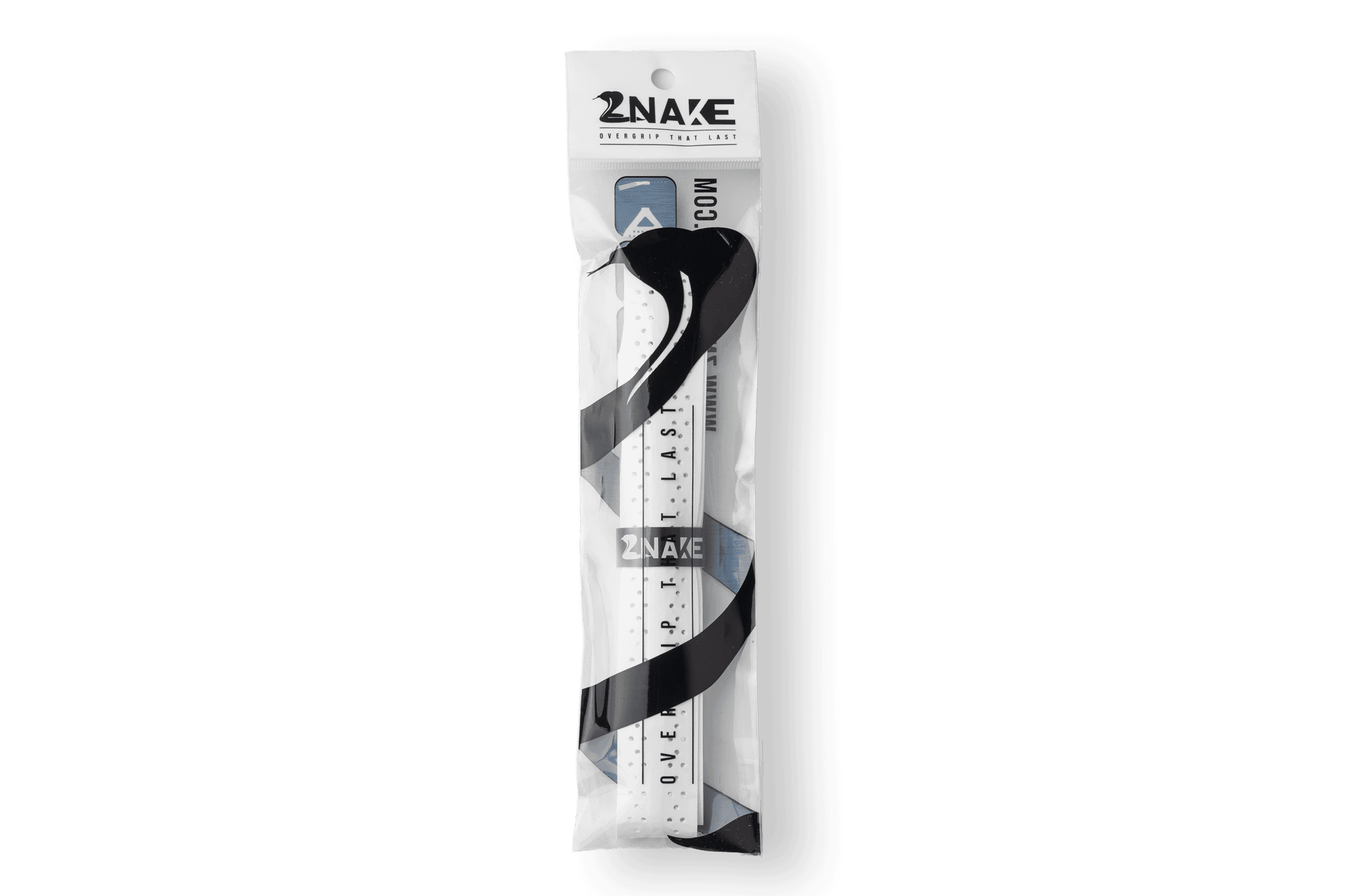
Viper Tennis has the raised ridge and a perforated PU surface. It is tuned for tennis – same DNA as the padel version, sized and adjusted for tennis rackets. The material is denser than standard wraps and lasts up to 3× longer.
Tacky or dry overgrip for tennis?
A tacky overgrip has a surface that clings to your hand, so the racket stays put even when you hold it loosely. A dry overgrip has no tack and gets its grip from the surface and from the material soaking up sweat.
In tennis, sweat matters a lot. Outdoor tennis in the heat puts more demand on absorption than on tackiness. A dry, ribbed surface moves moisture away better than a tacky wrap, which loses its grip once it is saturated.
Tacky suits you if you sweat little and want the grip to hold from the first shot. A wristband helps whichever wrap you choose: it catches the sweat before it reaches your palm and the grip.
Why does the overgrip have to be made for tennis?
A tennis racket has a longer handle than a padel racket. A wrap made for padel does not reach all the way, and a gap in the grip is something you feel immediately.
Viper Tennis is 1,070 mm long and 29 mm wide, compared with 990 mm for the padel wraps in the same range. Those extra 80 millimetres are what let the wrap run from the butt cap to the top of the handle on a tennis racket, with overlap the whole way.
So check the length before you buy, especially if a wrap is sold for several sports.
Does an overgrip make the grip thicker?
Yes, but only slightly – roughly half a grip size. The wrap sits on top of the base grip, and most players keep both layers for the cushioning. If you want to keep the exact original thickness, you can remove the base grip and use an overgrip on its own.
How tightly you wrap also changes the feel. Wrapping tighter makes the grip thinner and more direct; looser gives more cushioning. Both work, but stay consistent between changes so the feel does not shift from one wrap to the next.
How do you choose the right tennis overgrip?
Work through the questions in order. The answers point to your wrap, and once you have found it you just change to the same one again.
- Check the length: the wrap should be made for tennis rackets and cover the full handle.
- Think about sweat: if your hand gets wet, or you play outdoors in the heat, pick a dry wrap that soaks up moisture.
- Choose the surface: ribbed if you want an edge to lock your hand against, smooth if you change grips often and want even contact.
- Decide on the feel: tacky if you want the grip to hold instantly, dry if you want a clean feel without tack.
- Play at least one full session with the wrap, ideally one where you warm up properly, before you decide.
- Keep the same overlap and tension at the next change, so the feel stays the same.
Frequently asked questions
What is the best tennis overgrip?
The one that covers the full handle and suits your hand. Dry if you sweat or play outdoors in the heat, tacky if you want the grip to hold instantly, ribbed if you want an edge to lock your hand against.
What is a ribbed tennis grip?
A wrap with a raised strip that forms an edge around the handle once it is wound on. On Znake wraps the edge comes from an EVA foam strip down the centre of the wrap.
Should a tennis overgrip be tacky or dry?
It depends on sweat. A dry, ribbed surface moves moisture away better when you play outdoors in the heat, while a tacky wrap suits you if you want the grip to hold instantly.
Can you use a padel overgrip on a tennis racket?
The material works, but the length falls short. A padel wrap does not cover the longer tennis handle and leaves a gap you feel in your hand. Viper Tennis is 1,070 mm long, the padel wraps 990 mm.
How much thicker does an overgrip make the grip?
About half a grip size. Wrapping tighter keeps it thinner and more direct, looser gives more cushioning.
How much does a tennis overgrip weigh?
Viper Tennis weighs 7 grams. It is the wrap you change regularly – the base grip underneath stays on.
How long does a tennis overgrip last?
If you play a couple of times a week, a wrap usually lasts two to three weeks. The feel decides: once the surface turns slick or hard, the wrap has done its job.
Products in this guide
More guides
- How to put on a padel overgrip – step by stepHow to put on a padel overgrip: start at the butt, ridge facing down, 2–3 mm overlap and even tension. Done in under a minute.
- Tacky vs dry padel overgrip – which one suits you?Tacky, dry, ribbed or smooth? How to choose a padel overgrip for sweat, feel and playing style – and how to tell when it is worn out.
- How to put on a tennis overgrip – step by stepHow to put on a tennis overgrip: start at the butt, ridge facing down, 2–3 mm overlap and even tension. Plus base grip vs overgrip and when to change.